Uncollectible vs Uncollectable The correct spelling in standard English is uncollectible with an -ible ending. This form is the preferred choice in professional writing, especially in accounting and finance. You should always use uncollectible for debts or accounts that cannot be recovered. The version with -able is not considered correct in formal contexts.
The mix-up happens because the base word collect usually takes the suffix -ible to form collectible. The negative prefix un- then keeps that same -ible spelling pattern. In this guide you will learn the exact rule for choosing -ible over -able. You will also see clear examples for every common use of the word.
American and British
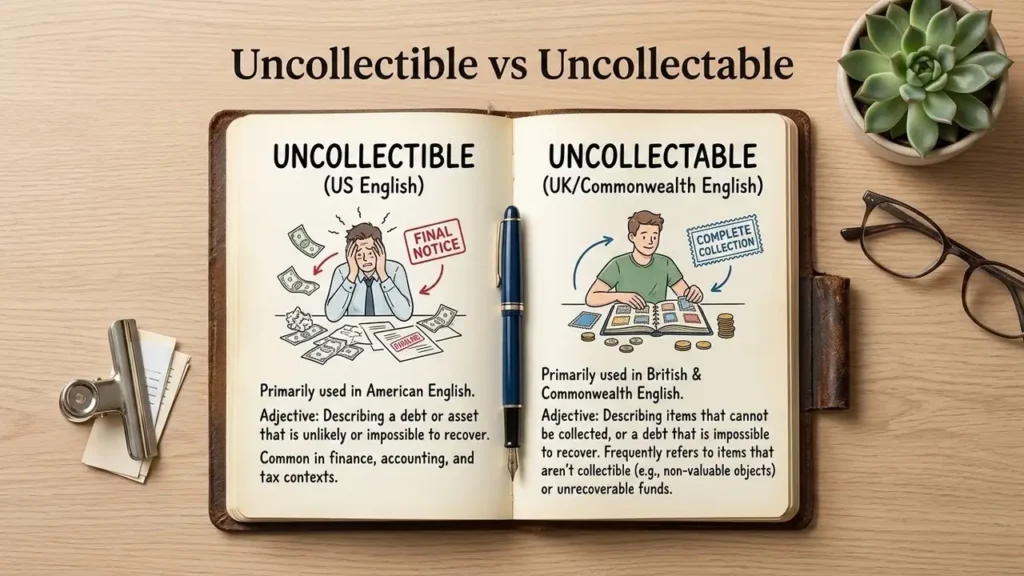
Both American and British English accept different spellings of this word. In the United States, the preferred form is uncollectible, with an -ible ending. British English uses uncollectable, with -able. For example, a US accountant might write “uncollectible accounts. ” while a UK accountant would write “uncollectable accounts.” The difference follows a. Broader pattern where -ible is more common in American English for certain words.

Quick Answer: Uncollectible vs Uncollectable
Uncollectible is the correct spelling in American and British English. It means “not able to be collected.” Uncollectable is an acceptable. Variant but is far less common and not recommended for formal writing. Always choose uncollectible for debt, accounts, and financial contexts.
| Correct Spelling | Incorrect Spelling | Usage Context |
|---|---|---|
| uncollectible | uncollectable | Accounting, finance, debt |
| collectible | collectable | Items worth collecting |
| irreversible | irreversable | Cannot be reversed |
| responsible | responsable | Accountable |
Uncollectible Meaning and Definition
This section explains what uncollectible means in general English and why it is the standard form. The word combines the prefix un- with collectible. It describes something that cannot be gathered or recovered. For example, a debt that a company cannot collect is uncollectible. This form appears in dictionaries and style guides as the preferred spelling. Understanding its core definition helps you choose the right spelling every time.
Uncollectible Definition
Uncollectible is an adjective meaning “not able to be collected or. Recovered.” It most often describes debts that a business cannot collect. Accounts receivable become uncollectible when a customer fails to pay. The word follows the pattern of collectible plus the negative prefix un-. This spelling is standard in accounting textbooks and financial reports. For instance, a bank may write off a loan as uncollectible after repeated attempts.

Uncollectible in Accounting and Finance
This section covers how uncollectible is used in professional accounting and financial contexts. Accountants apply this term to debts that cannot be recovered. The Financial Accounting Standards Board (FASB) uses uncollectible in its guidelines. These fields have made uncollectible the standard spelling in textbooks, standards, and reports. For example, the term appears in the Generally Accepted Accounting Principles (GAAP).
What Are Uncollectible Accounts?
Uncollectible accounts are amounts owed to a business that the business does not expect to receive. Accountants classify them as bad debts. Companies write off these accounts as an expense on their income statement. The term appears in accounting standards like GAAP and IFRS, always spelled uncollectible.

When Is Debt Considered Uncollectible?
Debt is considered uncollectible when the creditor has made reasonable. Efforts to collect and the debtor cannot or will not pay. Common signs include bankruptcy, a closed business, or a customer who has disappeared. The debt may also be too small to pursue legally. See Merriam-Webster grammar and usage guide for more.
| Indicator | Example |
|---|---|
| Bankruptcy filing | Customer files Chapter 7 |
| Debtor unreachable | Phone disconnected, no forwarding address |
| Statute of limitations expired | Debt too old to sue |
What Does Uncollectible Mean in Accounting?
This section explains the accounting definition of uncollectible and how it affects financial statements. The term is central to bad debt expense and the allowance method. See Cambridge Dictionary English grammar guide for more.
The Debt Write-Off Accounting Process
When a debt becomes uncollectible, the accountant removes it from accounts receivable. The direct write-off method debits Bad Debt Expense and credits Accounts Receivable. This method is simple but may not match expenses to revenues. The allowance method uses an estimated percentage of uncollectible accounts before the specific debt is identified. For instance, a company might estimate 2% of sales as uncollectible each year.
Example Accounting Entry
Here is a sample journal entry for writing off an uncollectible account of $500. The entry debits Bad Debt Expense for $500. It credits Accounts Receivable for the same amount. This entry removes the debt from the company’s books. The direct write-off method uses this approach for specific bad debts. The journal entry is recorded when the account is deemed uncollectible. This reduces the net realizable value of receivables.
| Account | Debit | Credit |
|---|---|---|
| Bad Debt Expense | $500 | |
| Accounts Receivable | $500 |
Uncollectable Meaning and Definition
This section covers the variant spelling uncollectable and its status in English. This spelling appears occasionally in British English texts. It is less common than uncollectible in American English. Knowing where it appears helps you avoid using it in formal writing. For example, some dictionaries list uncollectable as an alternative form. You may see it in older documents or non-standard usage.
Uncollectable Definition
Uncollectable has the same meaning as uncollectible: “not able to. Be collected.” Some dictionaries list it as a less common spelling. It appears mainly in British English contexts, but even there uncollectible is more frequent in financial writing. For instance, the Oxford English Dictionary notes both forms. In American English, uncollectible is the standard spelling. Financial reports and accounting standards almost always use uncollectible.

Is Uncollectable a Correct Spelling?
Yes, uncollectable is a correct spelling in the sense that it appears in some dictionaries. But, it is a variant, not the standard form. Style guides for accounting and business writing prefer uncollectible. Using uncollectable may look like a mistake to readers familiar with the standard.

Which Spelling Is Correct?
Uncollectible is the correct spelling for formal and professional writing. It follows the pattern of collectible and many other -ible words. Uncollectable is acceptable only in informal contexts or when following a style guide that permits it. For clarity and consistency, choose uncollectible.

Spelling Difference: -able vs -ible
The difference between -able and -ible lies in the root word. Collect comes from Latin colligere, which takes the suffix -ibilis to form collectibilis. English inherited the -ible spelling. Words from Latin that end in -ere or -ire often take -ible. This pattern explains why collectible is the preferred form. Other examples include audible from audire and credible from credere.
| Root word | Suffix | Correct form |
|---|---|---|
| collect | -ible | collectible |
| defend | -ible | defensible |
| convert | -ible | convertible |
English Spelling Rules: -able vs -ible
A general rule: if the root word is a complete English word, add -able (like washable). If the root is not a full word or comes from Latin, use -ible (like visible). Collect is a complete word, but its Latin origin dictates -ible. Exceptions exist, so check a dictionary.

Examples of Uncollectible in Sentences
Here are realistic sentences using the correct spelling uncollectible. The accountant wrote off the uncollectible account. The bank classified the loan as uncollectible after six months. The company’s policy requires immediate write-off of uncollectible debts. The IRS allows deductions for uncollectible business debts. Many textbooks use uncollectible as the default spelling.
- The company wrote off $10,000 in uncollectible accounts this quarter.
- Banks classify loans as uncollectible after 180 days of nonpayment.
- Our accountant estimated that 2% of sales will be uncollectible.
- She marked the invoice as uncollectible and closed the file.
Examples of Uncollectable in Sentences
These sentences use the variant spelling uncollectable. Note that they are less common and may be flagged by spell-checkers. For instance, “The debt was deemed uncollectable by the court.” Another example: “The charity considered the donation uncollectable.” But. Most style guides recommend uncollectible. Writers should be aware of the regional differences.
- The debt was deemed uncollectable after the debtor declared bankruptcy.
- Some old library fines become uncollectable after a few years.
- He argued that the charge was uncollectable due to a legal loophole.
- In British informal writing, you might see uncollectable used.
A Small Business Facing Uncollectible Debt
This section walks through a realistic scenario to show how uncollectible applies in practice. It reinforces the correct spelling through a concrete example. The scenario involves a small business owner deciding when to write off a bad debt. She reviews payment history and attempts collection. After several failed attempts, she marks the invoice as uncollectible. This mirrors real accounting procedures.
Scenario
GreenLeaf Landscaping has a customer, Joe’s Cafe, that owes $2,500 for work done three months ago. Joe’s Cafe closed suddenly, leaving no forwarding address. The owner, Maria, has called and emailed with no response. She concludes the debt is uncollectible. Maria then writes off the amount in her accounting software. She also notifies her accountant for tax purposes.
Accounting Decision
Maria decides to use the direct write-off method. She debits Bad Debt Expense for $2,500 and credits Accounts Receivable for the same amount. This removes the uncollectible account from her books and recognizes the loss in the current period. She chooses this method because the amount is small and not material to her financial statements. The direct write-off method is simple but does not follow GAAP for large companies.
Financial Impact
The write-off reduces GreenLeaf’s net income by $2,500. It also lowers accounts receivable on the balance sheet. Maria notes that future credit checks on customers might prevent similar uncollectible debts. The correct spelling uncollectible appears in all her records. She updates her credit policy to need background checks for new clients. This change aims to reduce future bad debt losses.
| Before Write-Off | After Write-Off |
|---|---|
| Accounts Receivable: $15,000 | Accounts Receivable: $12,500 |
| Net Income: $50,000 | Net Income: $47,500 |
Common Grammar Confusion With Uncollectible
Some writers confuse uncollectible with uncollectable because both sound natural when spoken. The confusion also comes from the word collectible itself, which some people misspell as collectable. Once you learn the standard -ible suffix, the grammar becomes clear. For instance, words like eligible and visible also use -ible. The -able ending is less common for this root.
Common Spelling Mistakes in English
The -able vs -ible error is one of the most common spelling mistakes in English. Words like responsible, visible, and sensible all use -ible. People often add -able because it is more frequent. For uncollectible, the mistake is writing uncollectable.
Uncollectible Pronunciation
Uncollectible is pronounced un-kuh-LEK-tuh-bul. The stress falls on the third syllable, just like in collectible. The un- prefix is unstressed and quick. Both spellings sound identical when spoken, which is why the confusion happens only in writing. The pronunciation follows the pattern of other -ible adjectives such as digestible. This phonetic similarity explains why writers often misspell the word.
What Is the Difference Between Collectible vs Collectable?
Collectible (with -ible) is the standard spelling for items worth collecting and for debts that can be collected. Collectable is a variant, less common in American English. The same rule applies to uncollectible: the -ible form is preferred.
| Word | Standard Spelling |
|---|---|
| collectible | Preferred in all contexts |
| collectable | Variant, less common |
Tips to Remember the Correct Spelling
This section gives practical memory aids to help you always choose uncollectible. One tip links the word to “collectible” with the same -ible ending. Another trick uses the phrase “I can collect it” to recall the -ible suffix. A third method compares the spelling to “eligible” and “incredible.” Each tip focuses on a different angle. You can find the one that sticks.
Rule 3: Think About Debt Write-Offs
When you think about writing off a bad debt, picture the word write-off next to uncollectible. Both words end with the letter f in sound, but uncollectible ends with ible. Connect the i in write-off to the i in uncollectible. This visual link helps you recall the correct spelling. You can also imagine the i as a hook that ties the two words together.
Mini Quiz: Uncollectible vs Uncollectable
Test your understanding with these short questions. One question asks you to fill in the blank with the correct form. Another presents two spellings and asks you to pick the right one. A third question contains a sentence with a deliberate error for you to find. Each one checks a different skill: filling in blanks, choosing the correct word, or spotting an error.
Fill in the Blank
- The accountant classified the debt as ___. (uncollectible / uncollectable) Answer: uncollectible — it is the standard spelling in accounting.
- She had a collection of rare ___. (collectibles / collectables) Answer: collectibles — the -ible form is preferred.
Choose the Correct Word
- Which sentence is correct?
A. The loan was deemed uncollectable after six months.
B. The loan was deemed uncollectible after six months. Answer: B — uncollectible is the standard spelling.
Spot the Error
- Find the mistake: “The company wrote off all uncollectable accounts.” Answer: Change uncollectable to uncollectible for formal writing.
Key Takeaways: Uncollectible vs Uncollectable
- Uncollectible is the correct spelling in American and British English.
- Uncollectable is a variant but not recommended for professional writing.
- The -ible ending comes from the Latin root of collect.
- Use uncollectible in accounting, finance, and legal documents.
Reference: Cambridge Dictionary Definitions
The Cambridge Dictionary lists uncollectible as the primary spelling. It defines the word as “an uncollectible debt is one that will not be paid.” The dictionary does. Not list uncollectable as a separate entry but notes it as a less common variant in some editions.
Frequently Asked Questions
Is uncollectable a real word?
Yes, uncollectable is a real word, though less common than uncollectible. It appears in British English and some dictionaries as an alternative spelling. But, in American English and professional accounting contexts, uncollectible is the standard and preferred form. You may encounter it in older texts or UK publications.
Which spelling is correct: uncollectible or uncollectable?
The correct spelling depends on your audience and region. Uncollectible is standard in American English and accounting, while uncollectable is accepted in British English. For consistency, use uncollectible in formal writing, especially financial documents. As it aligns with the -ible suffix rule for words derived from Latin.
How do you spell uncollectible?
You spell uncollectible as u-n-c-o-l-l-e-c-t-i-b-l-e. It is a 14-letter word with the suffix -ible. Remember the ‘i’ after the ‘t’ and before ‘b’. This spelling is consistent with other words like “collectible” and is the preferred form in American English.
What is the difference between uncollectible and uncollectable?
The difference lies in the suffix: uncollectible uses -ible, while uncollectable uses -able. Uncollectible is the standard spelling in American English and accounting. Whereas uncollectable is an alternative form more common in British English. Both mean the same thing: impossible to collect.
Why is uncollectible spelled with an i?
Uncollectible is spelled with an i because it derives from the Latin verb colligere, which takes the -ible suffix. English spelling rules dictate that words from Latin roots ending in -ible use ‘i’, unlike -able for native English words. This explains the ‘i’ in uncollectible.
Conclusion
The correct spelling for formal writing is always Uncollectible vs Uncollectable, with the -ible ending. This choice follows the standard Latin rule for words derived from Latin verbs ending in -ere. Dictionaries and accounting guides list only the -ible form as correct. You can trust this spelling in any professional or academic document.
The best memory trick is to link uncollectible to the word collectible, which also uses -ible. Both words share the same root and suffix pattern. When you see a debt or an account that cannot be paid, think of collectible first. This connection will help you choose Uncollectible vs Uncollectable correctly every time.

Reyansh is a passionate English language and grammar writer who enjoys making grammar, spelling, vocabulary, and writing concepts simple and easy to understand. With a focus on clear explanations and practical examples, Reyansh creates helpful content for students, writers, and everyday English learners. His goal is to make learning English more enjoyable, useful, and accessible to everyone.