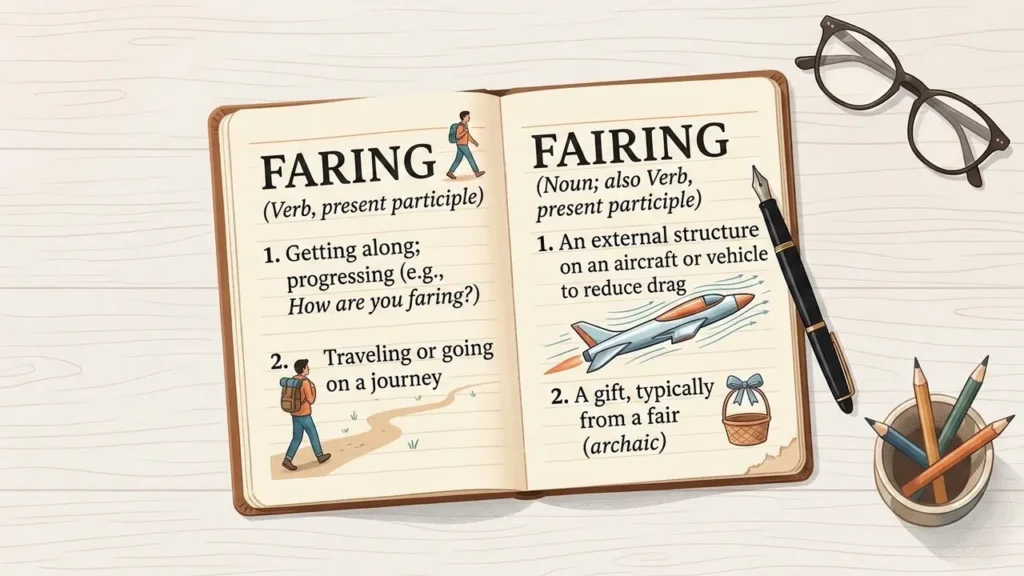
Faring vs Fairing answered directly: Faring is the correct word when you ask about someone’s condition or progress. As in “How are you faring?” Fairing is a noun for. A streamlined cover on vehicles or an old term for a gift. They are not interchangeable. Use faring for how things are going; use fairing for motorcycle parts.
The mix-up happens because both words sound the same when spoken quickly, but their roots are different. Faring comes from the Old English faran (to travel). Meanwhile, fairing comes from fair (beautiful) or Old French faire (to make). By the end of this article, you will confidently choose the right word every time.
Faring and Fairing in American and British English
Both faring and fairing are spelled and used the same way in American and British English. No regional spelling difference exists. Faring describes how someone is progressing or coping. Like asking “How are you faring?” Fairing is a structure that reduces air resistance in engineering contexts. Such as on motorcycles or aircraft. These words are homophones but have distinct meanings.
| Aspect | American English | British English |
|---|---|---|
| Spelling (faring) | faring | faring |
| Spelling (fairing) | fairing | fairing |
| Pronunciation | FAIR-ing (both words) | FAIR-ing (both words) |
| Example sentence (faring) | How are you faring with the new project? | How are you faring with the new project? |
| Example sentence (fairing) | The motorcycle’s fairing improves aerodynamics. | The motorcycle’s fairing improves aerodynamics. |
Quick Answer
Use faring for the verb meaning “getting along. ” and use fairing for the noun meaning a vehicle part or a gift. The mix‑up happens because they sound the same, but each word has a different job. Faring is about how you are doing; fairing is a physical object. Check the context to pick the right one.

How Are You Faring or Fairing Which Is Correct?
The correct phrase is “How are you faring?” because faring is the present participle of the verb fare. This means to get along or progress. This question asks about someone’s current state or well-being. It is a natural and common English expression. The verb fare has been used this way for centuries. You will hear it in both casual and formal conversation.
In contrast, “How are you fairing?” is incorrect. Fairing is not a verb meaning to get along. It is a noun for a streamlined cover on vehicles or an old word for a gift. The error happens because the two words sound alike. Always use faring when inquiring about someone’s condition. Stick with faring for progress questions; it is the only correct choice.

Faring Meaning: What It Actually Describes
Faring is the present participle of the verb fare. It describes how someone or something is getting along, progressing, or traveling. For example, “How are you faring in your new job?” means asking about your progress. It can also refer to literal travel. As in “The travelers are faring well on their journey.” It is often used in questions about well-being.
The verb fare comes from Old English faran meaning to go or travel. Over time, it expanded to include the sense of “to. Get along.” So faring always relates to how things are going. Whether in life, work, or a specific situation. It is not about beauty or fairness. Use faring to ask about someone’s health, progress, or experience. It is a versatile word for everyday English.

Fairing Meaning: A Completely Different World
Fairing is a noun, not a verb. Its most common modern meaning is a streamlined shell or covering on motorcycles, bicycles, or aircraft. This part reduces wind resistance and improves performance. For example, “The motorcycle’s fairing was damaged in the crash.” It can also refer to an old-fashioned gift or present. The word is technical in automotive contexts. It is never used to describe someone’s condition. See Merriam-Webster grammar and usage guide for more.
The origin of fairing is different from faring. It comes from the word fair meaning beautiful, or from Old French faire meaning to make. The gift sense comes from “fair” as in a festival. So fairing relates to making something fair or smooth, or giving a present. It has nothing to do with progress. In modern English, you will most often see it in motorcycle magazines or engineering manuals.

Difference Between Faring vs Fairing
The main difference is part of speech: faring is a verb form (present participle), while fairing is a noun. Faring describes an action or state of progressing. Fairing describes an object or a gift. They are not interchangeable. For example, you cannot say “I am fairing well” because fairing is not a verb. The spelling difference is just one letter: faring has one ‘i’, fairing has two. See Cambridge Dictionary English grammar guide for more.
Another difference is context. Faring appears in everyday conversation about well-being. Fairing appears in technical or historical contexts. If you are asking about someone’s health, use faring. If you are talking about a motorcycle part, use fairing. Knowing this distinction will prevent common mistakes. The two words are often confused because they sound identical. But their meanings are completely separate.

Comparison Table: Faring vs Fairing
This table summarizes the key differences between faring and fairing. The two words may sound the same, but their meanings and uses are distinct. The table below shows their parts of speech, meanings, and example contexts. Keep this comparison in mind when writing. It will help you choose the correct word every time. Refer to it whenever you are unsure.
| Feature | Faring | Fairing | Example |
|---|---|---|---|
| Primary Use | Describes progress or condition | Describes a streamlined cover or gift | “How are you faring?” vs “The motorcycle fairing is broken.” |
How Are You Faring: Correct Usage in Life
“How are you faring?” is a polite and slightly formal way to ask about someone’s condition. It is common in both spoken and written English. You might use it when checking on a friend who is ill or asking about a colleague’s new project. The phrase is also used in literature and news. It carries a tone of concern. It is more specific than “How are you?”
In everyday life, you can use “faring” in many contexts. For example, “How are you faring with the new software?” or “She is. Faring well after the surgery.” The word fits both positive and negative situations. It is versatile and clear. Avoid using “fairing” in these cases; it will confuse your reader. Stick with faring for all progress-related questions. Practice using it in your daily conversations.

How Are You Doing vs Faring
“How are you doing?” is the most common casual greeting in American English. “How are you faring?” is less common and sounds more formal or old-fashioned. Both ask about well-being, but faring implies a sense of progress or journey. You might hear “faring” more in British English or in writing. The choice depends on the tone you want. “Doing” is everyday; “faring” is more deliberate.
In many situations, they are interchangeable. But, “faring” often suggests a longer-term situation or a challenging experience. For example, “How are you faring in the heatwave?” sounds natural. “How are you doing?” is fine too. Use “faring” when you want to sound thoughtful or when writing formally. It adds a nuance of endurance. Both are correct, but know the difference. Choose based on context.
Faring in a Sentence: Real Usage You Can Learn From
Seeing faring in real sentences helps you understand its use. Here are a few examples: “The company is faring better than expected this quarter.” “He asked how I. Was faring after the move.” “The hikers are faring well despite the weather.” These show the word in business. Personal, and outdoor settings. Each sentence uses faring to describe progress or condition. Notice the verb form remains the same.
Faring Well Meaning and Its Variations
“Faring well” means that someone or something is doing well, progressing satisfactorily, or in good condition. For example, “The business is faring well despite the economy.” The opposite is. “faring poorly.” You can also say “faring better” or “faring worse” to compare. The word “well” is an adverb modifying the verb. This phrase is used in both formal and informal contexts. It is a standard expression.
Variations include “faring badly,” “faring okay,” or “faring no better.” These all follow the same pattern: faring + adverb. The adverb describes the degree of progress. For instance, “The students are faring badly in the exam.” Use these variations to be precise about the situation. They are all correct as long as you use faring. Never use “fairing” in these phrases. The meaning is clear with faring.
Is It Fairing Well or Faring Well?
The correct phrase is “faring well.” Faring is the present participle of fare, meaning to get along. “Fairing well” would be incorrect because fairing is not a verb and does not mean to progress. If you write “fairing well,” readers will think you are talking about a motorcycle part or a gift. The error is common but easy to fix. Always use faring in this context.
The confusion arises because “faring” and “fairing” are homophones. But, their meanings are different. “Fairing” as a verb is archaic and means to make smooth, but it is rarely used today. In modern English, “fairing well” is not a standard expression. Stick with “faring well” for all progress-related statements. This is the only correct form. Remember the rule: faring for progress, fairing for objects.
How Did You Fare Meaning (Past Tense Explained)
The past tense of fare is fared. So “How did you fare?” asks about how someone got along in the past. For example, “How did you fare in the interview?” means asking about the outcome. The verb fare is regular, so it simply adds -ed. Use fared for completed events. The phrase “how did you fare” is a natural question about past experience.
In contrast, “how did you fair” is incorrect because fair is not a verb meaning to get along. Fair as a verb means to make smooth, but it is rare and technical. Always use fared for past progress. For example, “She fared well in the competition.” This matches the pattern of faring in the present. Remember: fare → fared → faring.
Synonyms of Faring for Better Expression
If you want variety, use synonyms for faring that describe progress or condition. Common alternatives include getting along, progressing, doing, managing, and coping. For example, “How are you managing?” or “She is progressing well.” Each synonym carries a slightly different nuance. Getting along is casual; progressing is more formal. Choose based on context. These words can replace faring in most sentences.
Why People Confuse Faring and Fairing
The main reason is that faring and fairing are homophones – they sound exactly the same in speech. When you hear “How are you faring?” it sounds identical to “How are you fairing?” unless spoken carefully. This leads to spelling errors in writing. Many people are unaware that fairing is a noun, not a verb. The similarity in pronunciation tricks the ear. The mistake is common even among native speakers.
Another reason is the lack of familiarity with the word fairing. Most people know fair as an adjective meaning just or beautiful. So they assume fairing is the verb form of fair. But fair as a verb is rare. Meanwhile, faring is less common in everyday speech, so people default to the spelling that looks familiar.
Mini Quiz: Faring vs Fairing
This short quiz will test your understanding of the difference between faring and fairing. Each section below gives you a chance to practice choosing the correct word. Use what you have learned about their meanings and parts of speech. The quiz covers fill-in-the-blank, error spotting, and word choice. Complete each part to reinforce your knowledge. Then check your answers to see how well you know the difference.
Fill in the Blank
Answers: 1. faring (progress after storm), 2. fairing (motorcycle part), 3. faring (progress). If you got all three right, you understand the difference. If not, review the meanings. The key is remembering that faring is always about progress, and fairing is about an object. Practice with more sentences on your own. This will build your confidence. Use the rule every time you write.
Spot the Error
Find the mistake in this sentence: “He is fairing well. After the surgery.” The error is using fairing instead of faring. The correct sentence is: “He is faring well after the surgery.” Fairing cannot describe progress. This is a common error. Always check the meaning before writing. If you spot it, you are on the right track.
Choose the Correct Word
Which word fits this sentence: “The business is ___ despite the recession”? Options: faring or fairing. The correct choice is faring because it describes progress. Now try: “The mechanic replaced the damaged ___.” Options: faring or fairing. The correct choice is fairing because it refers to a vehicle part. If you chose correctly both times, you have mastered the difference. Use this logic in all your writing.
Quick Final Reminder
Remember this simple rule: faring is for progress, fairing is for objects. If you are asking about someone’s well-being, use faring. If you are talking about a motorcycle or aircraft part, use fairing. This one distinction will prevent all errors. Keep it in mind whenever you write these words.
Frequently Asked Questions
Is ‘fairing’ a real word?
Yes, ‘fairing’ is a real word. It is a noun that refers to a structure on vehicles to reduce drag or a gift given to someone. It is not related to the verb ‘fare’. The word appears in engineering and nautical contexts.
Can ‘fairing’ be used for people?
No, ‘fairing’ cannot be used for people. It is a noun for aerodynamic parts or gifts, not for describing someone’s condition. The verb ‘fare’ is used for people, as in the phrase ‘how are you faring’. Fairing is a different word entirely.
How do you pronounce ‘faring’ and ‘fairing’?
‘Faring’ is pronounced with a long ‘a’ sound like ‘air’, while ‘fairing’ is pronounced the same way. Both are homophones, meaning they sound identical. The difference lies in spelling and meaning, not pronunciation. You may hear them spoken exactly the same in conversation.
Is ‘fare’ a regular or irregular verb?
‘Fare’ is a regular verb. Its past tense is formed by adding -ed, making ‘fared’. For example, ‘He fared well in the competition.’ It does not change its stem like irregular verbs. This makes it easy to conjugate in all tenses.
What is the noun form of ‘fare’?
The noun form of ‘fare’ is also ‘fare’. It means the price of transportation or food provided. For example, ‘bus fare’ or ‘good fare at the restaurant.’ It is distinct from the verb meaning. This noun usage is common in everyday language.
Conclusion
The core difference between Faring vs Fairing is about meaning, not spelling. Faring always describes how a person or journey is progressing, like asking how you are faring. Fairing names a smooth panel on a vehicle or a small gift from a fair. You must choose faring for condition and fairing for objects, and this rule never changes.
Try this simple memory trick to lock in the rule. Think of the word “fare” inside faring, which sounds like the cost of a trip. Fairing contains the letters “air” like the air flowing over a motorcycle shell. Now you can separate Faring vs Fairing every time without doubt. Practice this trick, and your writing will stay correct.

Reyansh is a passionate English language and grammar writer who enjoys making grammar, spelling, vocabulary, and writing concepts simple and easy to understand. With a focus on clear explanations and practical examples, Reyansh creates helpful content for students, writers, and everyday English learners. His goal is to make learning English more enjoyable, useful, and accessible to everyone.